


Agrimony vs plantain leaf compares two traditional aerial-herb products that differ in taxonomy, plant part, leaf structure, and common extract formats. Agrimony usually refers to the flowering tops of Agrimonia eupatoria. Herbal plantain may refer to leaves from a Plantago species, most often Plantago lanceolata or Plantago major.
The word “plantain” creates an extra identity problem. It can describe a low-growing Plantago herb or a banana-like fruit from the genus Musa. These plants are not close substitutes. The botanical name on the product label resolves the ambiguity.
Are Agrimony and Plantain Leaf the Same Herb?
No. Agrimony and plantain leaf come from different plant families, genera, and species.
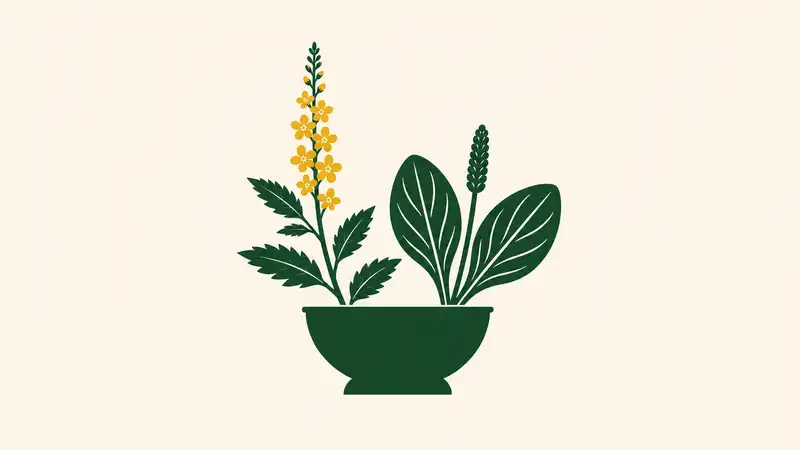
Agrimonia eupatoria belongs to the Rosaceae family. It is an upright herb with toothed leaves and a narrow spike of small yellow flowers. Herbal preparations commonly use its dried flowering tops.
Plantago lanceolata and Plantago major belong to the Plantaginaceae family. Both grow in low leaf rosettes, but their leaves look different. Plantago lanceolata has narrow, lance-shaped leaves. Plantago major has broader, oval leaves.
The shared description “aerial herb” is too broad to establish equivalence. A flowering top and a leaf are different botanical materials even when both grow above ground.
Which Plant Does the Name Plantain Identify?
The name plantain can identify unrelated plants. Context helps, but a Latin name provides the clearest answer.
Plantago herb
Herbal plantain usually belongs to the genus Plantago. Ribwort plantain is Plantago lanceolata. Broadleaf plantain is Plantago major. Both belong to Plantaginaceae and the order Lamiales.
Banana-like plantain
The starchy fruit called plantain comes from cultivated plants in the genus Musa. These plants belong to the Musaceae family and the order Zingiberales. Their fruit is a food ingredient, not Plantago leaf material.
A package that says only “plantain” leaves the botanical identity unclear. Look for Plantago lanceolata, Plantago major, or a precisely identified Musa taxon.
What Are the Main Agrimony vs Plantain Leaf Differences?
The key differences involve taxonomy, harvested plant part, appearance, and preparation type.
| Comparison point | Agrimony | Plantain leaf | Plantain fruit |
|---|---|---|---|
| Typical identity | Agrimonia eupatoria | Plantago lanceolata or Plantago major | Cultivated Musa plants |
| Botanical family | Rosaceae | Plantaginaceae | Musaceae |
| Growth form | Upright flowering herb | Low-growing rosette herb | Large tropical herbaceous plant |
| Relevant material | Flowering tops | Leaves or a separately declared fresh herb | Starchy fruit |
| Typical appearance | Small yellow flowers with toothed leaves | Narrow or broad leaves with prominent parallel veins | Elongated banana-like fruit |
| Common product formats | Cut herb, tea, tincture, and liquid extract | Cut leaf, powder, tea, juice, and dry or liquid extract | Fresh, cooked, dried, or milled food |
| Main label check | Species and flowering-top disclosure | Exact Plantago species and leaf or herb disclosure | Musa identity and food format |
This table describes product identity. It does not imply equivalent composition or expected performance between the listed materials.
How Do Their Plant Parts Differ?
Agrimony preparations generally use flowering tops. Plantain leaf products use leaves, although some Plantago lanceolata preparations may use fresh herb for expressed juice.
Agrimony flowering tops
Flowering tops can contain flowers, buds, upper leaves, and sections of stem. The composition therefore reflects a mixture of structures collected during the flowering stage.
Plantago leaves
A leaf product should identify the species and specify leaf or folium. Products based on Plantago lanceolata may also distinguish dried leaves from expressed juice made with fresh herb.
Do not assume that leaf, aerial parts, herb, and expressed juice mean the same starting material. These terms describe different manufacturing inputs.
How Do Agrimony and Plantain Leaf Teas Compare?
Both materials can appear as herbal teas, but they differ in plant part and sensory profile. Package directions should control the quantity, water temperature, and steeping period.
Agrimony tea commonly uses cut flowering tops. It may taste herbal, mildly bitter, and astringent. Astringency is the dry or puckering sensation associated with compounds such as tannins.
Plantain leaf tea commonly tastes green, grassy, earthy, or mildly bitter. Plantago lanceolata and Plantago major should not be combined into one undefined ingredient unless the label clearly identifies a blend.
Similar color or bitterness does not establish equal composition. Harvest stage, cut size, storage, species, and brewing method can change the finished infusion.
How Do Their Liquid Extracts Differ?
A liquid comparison requires more than checking bottle size. Confirm species, plant part, fresh or dried starting material, extraction ratio, solvent, and intended route.
For the Agrimony portion of the comparison, editors can reference this Agrimony tincture listing while identifying plantain by its full botanical name. The online page is a format example, not evidence that another liquid uses equivalent raw material or extraction conditions.
Plantago lanceolata appears in several preparation types, including water extracts, ethanol extracts, expressed juice, powders, and dried leaf. These formats cannot be collapsed into one generic plantain liquid.
Agrimony and plantain extracts may use different ratio systems. A larger ratio number is not automatically a stronger or better product. The ratio must be interpreted with its botanical material and solvent.
Is Plantain Leaf the Same as Psyllium Husk?
No. Both may come from the genus Plantago, but plantain leaf and psyllium husk are different plant parts and product categories.
Psyllium products generally use seed husk from specified Plantago species. Plantain leaf products use leaves from a named species such as Plantago lanceolata or Plantago major.
Genus membership does not make a leaf equivalent to a seed coat. Labels and research must match the exact species and plant part.
Can Research on One Product Apply to the Other?
No. Research on agrimony flowering tops cannot establish facts about plantain leaves, and findings for one Plantago species cannot automatically describe another.
A useful research match requires the following details:
- Complete botanical name
- Exact plant part
- Fresh or dried starting material
- Preparation and extraction method
- Solvent and extraction ratio
- Finished product format
Historical documentation also needs species-level reading. A common name recorded as plantain may refer to a locally familiar Plantago species rather than every member of the genus.
How Should You Compare the Product Labels?
Start with identity. An agrimony label should state a species such as Agrimonia eupatoria. A plantain leaf label should state a Plantago species rather than using “plantain” alone.
Next, identify the raw material. Look for flowering tops, leaf, herb, aerial parts, powder, or expressed juice. Then classify the finished product as tea, capsule, tincture, dry extract, or liquid extract.
Read the complete ingredient panel for carriers, flavors, sweeteners, preservatives, and other botanicals. Front-label words such as traditional, concentrated, premium, or natural do not replace botanical specifications.
Plant Identity Checklist
Use this checklist before comparing agrimony with any product labeled plantain. It separates taxonomy from format and removes ambiguity around the common name. Complete every step before comparing price or serving size.
Find the Latin name
Confirm Agrimonia eupatoria, a named Plantago species, or a Musa identity. Do not accept plantain alone as complete identification.
Confirm the plant part
Check for flowering tops, leaf, herb, juice, fruit, seed, or husk. Each term identifies a different botanical input.
Separate herb from fruit
Determine whether plantain means a Plantago herb or banana-like Musa fruit. These categories are unrelated for product comparison.
Identify the format
Classify the item as tea, powder, capsule, tincture, expressed juice, dry extract, or liquid extract.
Read the carrier
Check whether a liquid contains water, ethanol, glycerin, or another carrier. Carrier information helps define the preparation.
Interpret ratios carefully
Record the starting material and ratio basis. Do not rank products by ratio numbers without matching definitions.
Match research to the label
Use information only when the species, plant part, processing method, and format align with the product.
What Does Ashwagandha and Alcohol Show About Ambiguous Terms?
Ashwagandha and Alcohol is a separate subject, but it illustrates the same language problem. Alcohol may describe a solvent used during extraction or a beverage consumed independently. Those meanings should not be merged. Precise context matters just as much when “plantain” can mean a Plantago leaf or a Musa fruit.
FAQ
Are agrimony and plantain leaf the same herb?
No. Agrimony usually means Agrimonia eupatoria, while plantain leaf comes from a named Plantago species.
Is plantain leaf related to plantain fruit?
No. Plantain leaf products use Plantago. Banana-like plantain fruit comes from cultivated Musa plants.
Which Plantago species appears in herbal products?
Plantago lanceolata and Plantago major are common examples. The label should identify the exact species.
Which part of agrimony is commonly used?
Agrimony products commonly use dried flowering tops containing flowers, leaves, and upper stems.
Which part of Plantago is used in plantain leaf products?
Plantain leaf products use leaves. Some separately defined preparations use fresh herb to produce expressed juice.
Is plantain leaf the same as psyllium husk?
No. Plantain leaf is leaf material, while psyllium husk is the outer layer of seeds from specified Plantago species.
Can agrimony tincture be compared directly with plantain tea?
No. The species, plant parts, solvents, processing methods, and serving units differ.
Why is the botanical name important?
It distinguishes unrelated plants that share a common name and identifies the species used in a product.
Glossary
Aerial parts
The portions of a plant that grow above the ground.
Botanical name
A scientific name that identifies a plant by genus and species.
Expressed juice
Liquid obtained by mechanically pressing fresh botanical material.
Flowering tops
Upper plant material collected during flowering, often including flowers, leaves, and stems.
Folium
A Latin pharmacognosy term meaning leaf.
Plantago
A genus of herbs in the Plantaginaceae family.
Plant part
The specific botanical structure used in a product, such as leaf, flower, seed, or fruit.
Psyllium husk
Seed-coat material from specified species within the genus Plantago.
Tincture
A liquid botanical extract made with a declared solvent system.
Conclusion
Agrimony and plantain leaf differ in family, species, harvested material, appearance, and common formats. Confirm the full botanical name because plantain can identify either a Plantago herb or an unrelated banana-like fruit.
Sources Used
- Accepted taxonomy and family for Agrimonia eupatoria, Plants of the World Online – powo.science.kew.org/taxon/316550-2
- Accepted taxonomy and family for Plantago lanceolata, Plants of the World Online – powo.science.kew.org/taxon/321285-2
- Agrimony flowering-top and liquid-extract definitions, Agrimoniae herba – ema.europa.eu/en/medicines/herbal/agrimoniae-herba
- Accepted taxonomy and family for Plantago major, Plants of the World Online – powo.science.kew.org/taxon/321286-2
- Accepted taxonomy for the plantain-fruit hybrid Musa paradisiaca, Plants of the World Online – powo.science.kew.org/taxon/797595-1
- Ribwort plantain leaf and preparation definitions, Plantaginis lanceolatae folium – ema.europa.eu/en/medicines/herbal/plantaginis-lanceolatae-folium
- Current ribwort plantain preparation specifications, European Union herbal monograph – ema.europa.eu/en/documents/herbal-monograph/european-union-herbal-monograph-plantaginis-lanceolatae-folium-revision-1
- Retail reference for an Agrimony liquid format, Agrimony Tincture product page – secrets.shop/products/agrimony-tincture